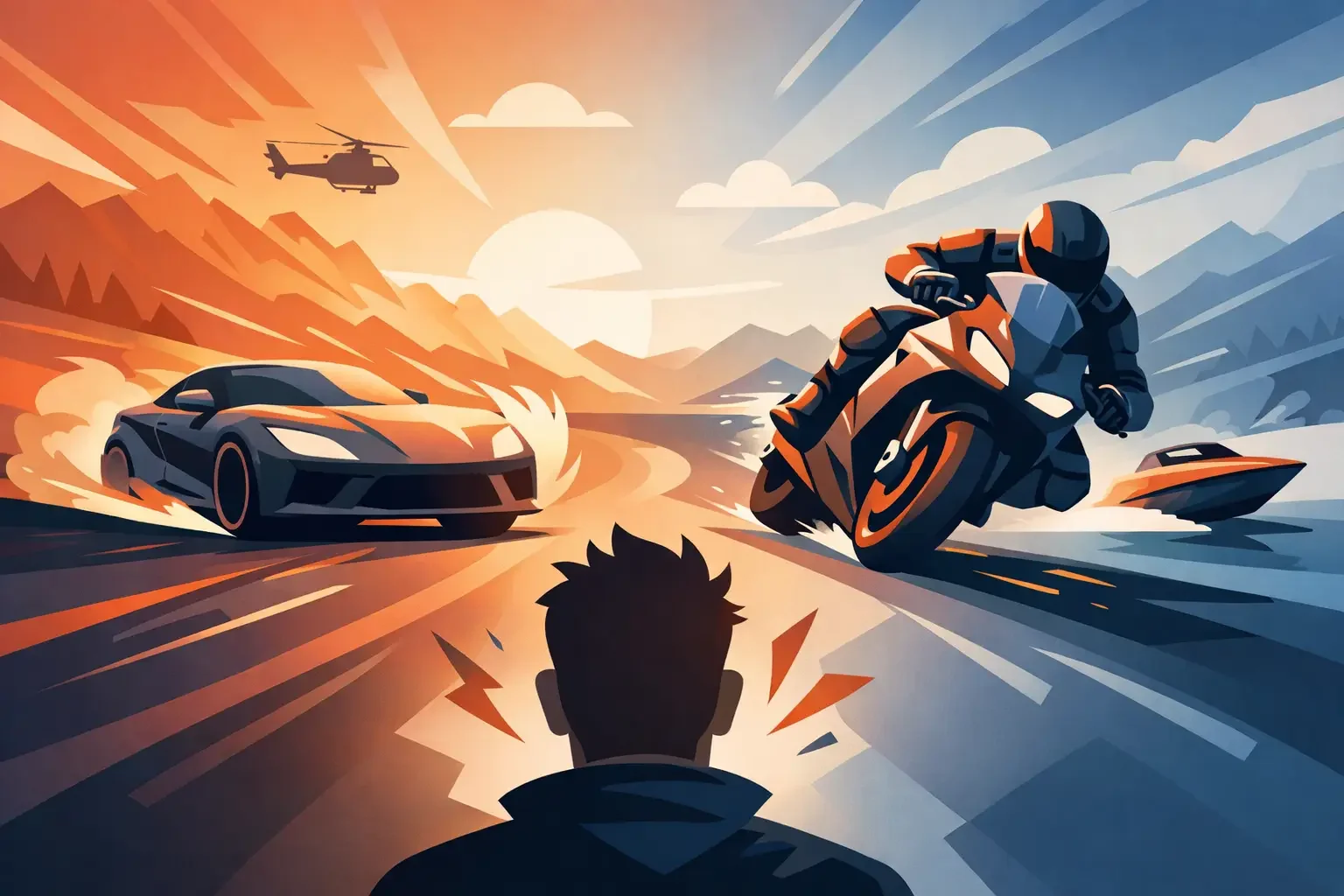
A good racing scene should feel like bad decisions at 180 miles per hour.
That is the whole appeal of adrenaline racing fiction. It is not just about cars, bikes, tracks, or checkered flags. It is about velocity with consequences. Metal scrapes. Engines scream. Rivalries turn personal. One wrong move can wreck a season, a career, or a life. For readers who want fiction to hit like a nitrous shot, this genre does not ease into the action. It drops the hammer.
What adrenaline racing fiction actually delivers
At its best, adrenaline racing fiction runs on more than speed. Speed is the surface thrill. The real engine is pressure.
A strong racing novel puts characters inside a machine built for disaster. Every lap tightens the screws. Every opponent wants something. Every sponsor, crew member, lover, rival, and enemy adds weight to the next decision. The race itself matters, but the story gets teeth when winning costs too much and losing costs even more.
That is why the genre works for readers who also love thrillers, suspense, crime fiction, and action-heavy science fiction. The same fuel is there - danger, momentum, and a hero who cannot afford to blink. Racing just gives that tension a brutal, visual frame. You can see the wall coming.
There is also a physicality to it that many other genres struggle to match. The cockpit is cramped. The track is loud. The body takes a beating. Fear is not abstract when a machine can kill you because a bolt failed, a tire blew, or the driver in second place decided to get reckless.
Why speed alone is never enough
Plenty of stories include racing. Not all of them earn the label.
If the book only offers technical detail, it can start reading like a manual with a body count. If it only throws in a few flashy race scenes without emotional stakes, the action turns hollow fast. Readers may love horsepower, but they stay for conflict.
The best adrenaline racing fiction understands that velocity means nothing without vulnerability. A driver chasing redemption is interesting. A driver chasing redemption while hiding a sabotage scandal, dodging a dangerous rival, and trying not to implode under pressure is a story.
That balance matters. Too much realism can bog the pace down. Too little realism can make the stakes feel fake. Most readers are not looking for a textbook on suspension tuning. They want enough detail to believe the world, then they want the story to floor it.
The core ingredients of a great racing novel
The strongest books in this lane usually share a few traits, even when the setting changes from street racing to professional circuits to futuristic death tracks.
First, the protagonist needs a reason to race that goes beyond simple love of speed. Maybe they are running from debt, chasing revenge, protecting family, or clawing their way back from a public crash. Desire sharpens the story. Desperation makes it dangerous.
Second, the rival cannot be generic. A faceless competitor is fine for one scene. Not for a full novel. The best rivals carry history, ego, and menace. They know exactly where to hit the hero where it hurts, whether that means on the track or off it.
Third, the world around the race needs friction. Crews break. Sponsors manipulate. Officials bend rules. Criminal money enters the garage. Romance gets messy. Secrets leak. A straight line from race one to race ten is not enough. The chaos around the event is what gives the event power.
Finally, the race scenes themselves have to escalate. If every showdown feels the same, readers stop feeling the danger. A street race through wet city blocks hits differently than a sanctioned event with corporate pressure and a target on the driver’s back. Variety keeps the engine hot.
What readers love about adrenaline racing fiction
This genre scratches a very specific itch. It gives readers motion, but it also gives them impact.
A lot of suspense novels move through investigation. A lot of action novels move through combat. Racing fiction moves through pursuit. That creates a different kind of tension. It is not just about surviving an attack. It is about forcing your way through a narrowing gap before everything collapses.
That urgency is addictive. Even in quieter scenes, the story feels loaded. The next race is coming. The next betrayal is brewing. The machine in the garage might be the answer or the trap. That constant forward pull makes racing fiction perfect for readers who hate slow burns that never catch fire.
There is wish fulfillment here too, and it matters. Most people will never push a machine to its limit in front of a hostile crowd with money, pride, and blood on the line. Fiction lets them feel that edge without paying the hospital bill.
But pure fantasy is not enough. Readers want grit with the glamour. They want grease under the nails, bruises under the fire suit, and the sense that every victory was dragged out of the wreckage.
Adrenaline racing fiction across subgenres
One reason this category has range is that it plays well with other genres.
In a thriller, racing becomes a pressure cooker for conspiracy, sabotage, and revenge. The hero is not just trying to win. They are trying to survive long enough to expose what is really happening under the hood.
In crime fiction, the race can be the transaction point, the cover, or the battlefield. Illegal circuits, smuggling operations, and rigged outcomes all add a dirty pulse that fits naturally with the genre.
In science fiction, racing gets even meaner. Swap asphalt for hostile planets, prototype vehicles, military tech, or outlaw competitions where the machines are barely stable and the organizers barely human. The appeal stays the same, but the scale goes wild.
Even paranormal or speculative stories can use racing well if the rules stay sharp. The danger still has to feel immediate. Supernatural elements can raise the stakes, but they should not erase them.
That flexibility is part of the draw. Readers who like action-first stories often move across genres, and racing fiction gives them a familiar charge in different forms.
Why cinematic writing matters here
This is not a genre built for polite distance.
The prose has to move. Not every sentence needs to sound like a crash, but the writing should carry impact. Short bursts help in race scenes. Clean detail helps readers track the action without getting lost. Strong verbs do more work than bloated description ever will.
Cinematic storytelling is especially useful because racing is visual, spatial, and physical. Readers need to know where the threat is and why it matters right now. If the scene is muddy, the tension dies.
That does not mean nonstop noise. Quiet moments matter because they load the chamber. A tense garage conversation before the green light can hit just as hard as the race itself if the conflict is real. Good pacing is not constant speed. It is controlled acceleration.
That is one reason readers who enjoy high-impact commercial fiction tend to gravitate toward this genre. When it is done right, it reads like a film with the brakes cut.
The trade-off every racing story has to manage
There is one challenge built into the genre. Racing is repetitive by nature. Practice, qualifying, race day, repeat. If a story leans too hard on the event structure, it can start to feel mechanical.
The fix is not abandoning the races. It is making each one change the story.
One event should expose a traitor. Another should destroy trust between teammates. Another should force the protagonist to choose between winning and protecting someone they care about. If the only question is who finishes first, the book loses punch. If the race changes relationships, power, and survival odds, every lap matters.
Character depth matters here too, but not in a slow, literary way. This audience does not want pages of navel-gazing while engines cool in the background. They want emotional stakes delivered with force. Fear. Obsession. Guilt. Rage. Hunger. Give the reader something sharp enough to cut through the action.
Who should read adrenaline racing fiction
If you want elegant introspection and minimal plot, this probably is not your lane.
If you want fiction with momentum, impact, and characters pushed to the edge, it absolutely is. This genre fits readers who love thrillers with teeth, action stories that do not stall, and suspense built on movement instead of endless setup. It works for people who want escape, but not softness. Entertainment, but with consequences.
That is a big part of why it holds up. Adrenaline is the hook, but pressure is the payoff. The speed gets you in. The danger keeps you reading.
For readers chasing that next high-octane story, adrenaline racing fiction offers something brutally simple and wildly effective: a machine, a threat, and a protagonist with no safe way out. Sometimes that is all a great night of reading needs.