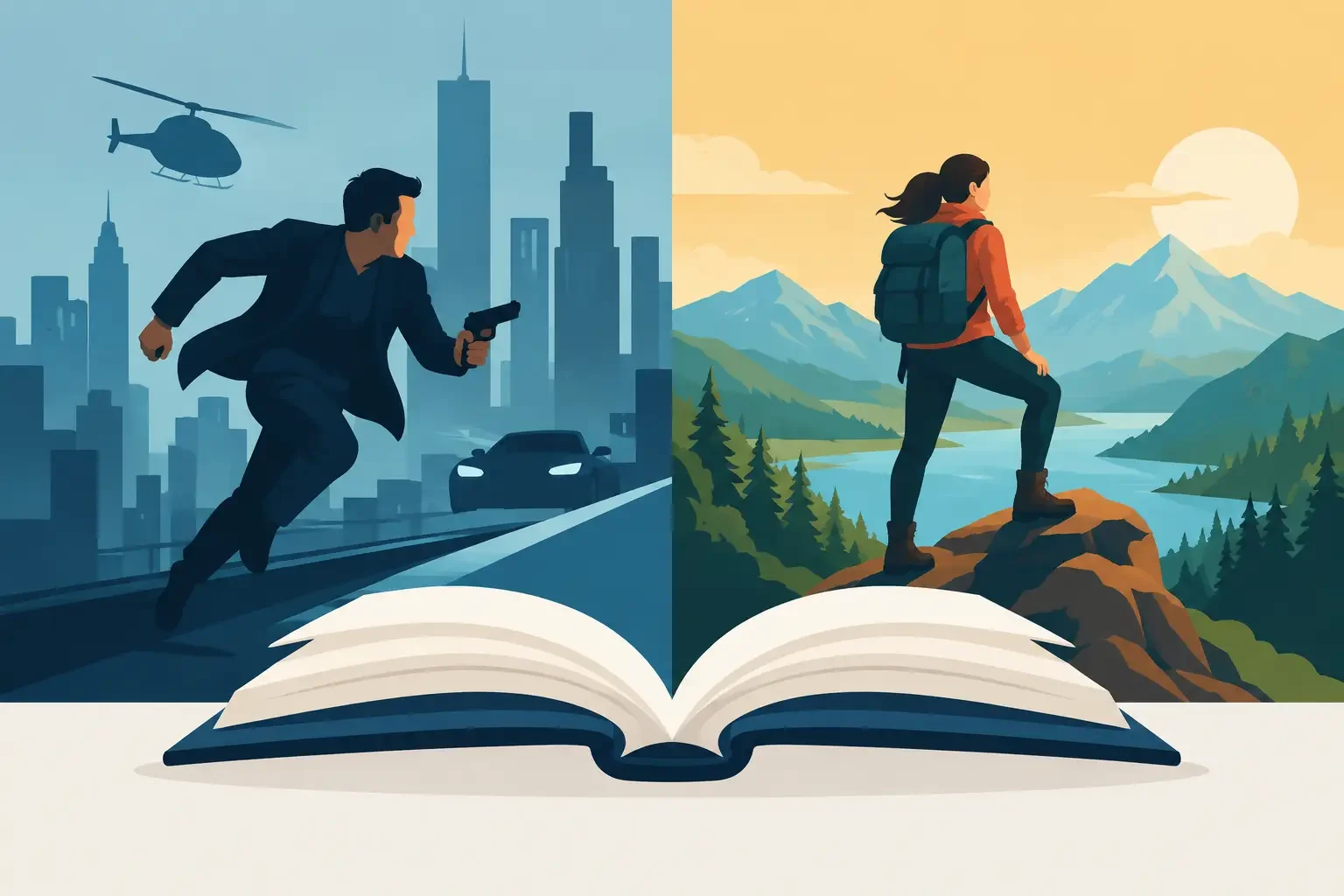
A helicopter tears across a stormy sky. A relic hunter steps into a sealed tomb. A fugitive has one night to expose a conspiracy before a kill team finds him. All three setups promise danger, but action novels versus adventure novels deliver that danger in different ways. One hits the gas from page one. The other pulls readers beyond the map, then makes survival the price of discovery.
For readers who want chases, gunfire, impossible escapes, lost worlds, secret experiments, and heroes with nowhere safe to stand, the distinction matters. It helps you pick the right kind of rush before you crack the spine.
Action Novels Versus Adventure Novels: The Core Split
An action novel is built around immediate conflict. The protagonist is under pressure, usually from an enemy with the means and intent to hurt them now. A kidnapping, assassination, manhunt, terrorist threat, prison break, street war, or revenge mission creates a ticking clock. Scenes tend to move like falling dominoes: a threat appears, somebody makes a desperate move, the consequences hit hard, and the next threat gets worse.
Adventure novels are driven more by the journey. The danger is real, but discovery is often the engine. The characters might hunt a missing expedition, cross hostile territory, chase a legendary treasure, investigate an alien planet, or enter a place no sane person would go twice. The goal is not simply to beat an enemy. It is to reach something unknown, uncover a truth, or survive a world that keeps changing the rules.
Put simply, action asks, “How does the hero get out alive?” Adventure asks, “What is waiting beyond the next horizon?” Great books often answer both questions at once.
What Makes an Action Novel Hit Hard
Action fiction thrives on momentum. Its strongest scenes force decisions under fire. The hero cannot spend three chapters calmly weighing options when armed men are smashing through the door. They run, fight, bluff, drive, hide, or make a mistake that turns a bad situation into a disaster.
That does not mean action is empty spectacle. The best action stories make every collision personal. A cop hunts the killer who destroyed her family. A former soldier is dragged back into a life he tried to bury. A racer risks everything to expose sabotage that has already claimed lives. The fists, bullets, and explosions work because they are attached to something the character cannot walk away from.
Action novels also tend to stay close to the main threat. Locations can change fast, but every stop serves the central conflict. A warehouse ambush leads to a highway chase. The chase leads to a safe house betrayal. The betrayal points to the person at the top. The plot moves forward with the blunt force of a battering ram.
Readers who love thrillers, revenge stories, crime fiction, military suspense, and survival tales often gravitate toward action novels. They want danger with a pulse. They want a protagonist who gets knocked down, gets angry, and gets back up before the enemy can reload.
What Makes an Adventure Novel Feel Bigger
Adventure gives the story room to roam. The protagonist may still face armed enemies, collapsing structures, monsters, storms, and betrayals, but the setting carries more weight. A jungle, deep-sea wreck, abandoned colony, desert highway, haunted mountain pass, or distant moon is not just scenery. It is part of the opposition.
The sense of possibility is crucial. Adventure fiction invites readers to wonder what else is out there. The answer might be a vanished civilization, a black-market operation, a paranormal force, an artifact with a body count, or a planet with teeth. The hero usually begins with a mission, but the mission grows as new clues reveal a larger mystery.
Adventure can be fast, but it often uses a different rhythm from pure action. There may be a breath between disasters: a cryptic map decoded in a roadside motel, a strange signal picked up in deep space, a tense conversation with the only guide who knows the way in. Those moments build atmosphere and anticipation. They make the next attack land harder.
If you like science fiction journeys, treasure hunts, paranormal expeditions, wilderness survival, and stories where the world itself has secrets, adventure novels are built for you.
The Overlap Is Where the Fun Starts
The line between these genres is not a concrete wall. It is a pressure point. A story can be an action-adventure novel if it combines a hard-driving threat with a dangerous quest.
Imagine a disgraced detective racing through a flooded city to stop a cult from opening something ancient beneath the subway. The chase, fights, and ticking clock lean action. The buried history, strange ritual, and descent into the unknown lean adventure. Remove the quest and the story becomes a straight thriller. Remove the immediate threat and it becomes a slower mystery expedition.
Science fiction makes the blend especially potent. A crew might explore a dead station at the edge of the solar system, which sounds like adventure. Then the station wakes up, locks the exits, and starts hunting them. Now the book has teeth, speed, and a body count.
That crossover is a natural home for readers who do not want to choose between mayhem and mystery. A Jay Sauls-style high-intensity story can use the raw urgency of action while throwing characters into places where the danger is bigger, stranger, and far less predictable than a single enemy with a gun.
Pacing: Speed Is Not the Only Difference
Readers sometimes assume action novels are always fast and adventure novels are always slower. Usually, that is true in broad strokes, but it is not the whole story.
Action pacing is relentless because the protagonist is reacting to direct danger. Even quieter scenes carry tension. Someone is lying. Someone is listening. The next move has to happen before time runs out. The story creates urgency through conflict.
Adventure pacing can shift gears more often. A novel may sprint through a cliffside escape, slow down for the discovery of an impossible ruin, then sprint again when the ruin proves to be a trap. The story creates momentum through escalation and revelation. Each new location or discovery should make the stakes larger, not merely send the characters on another scenic detour.
Neither approach is automatically better. If you want a book for a late-night binge, when you tell yourself “one more chapter” until it is suddenly 2 a.m., action may be the better bet. If you want to feel transported to a dangerous new world while still getting your share of chaos, adventure may be the stronger fit.
Stakes and Heroes Change the Flavor
An action hero is often defined by capability under pressure. They may be a detective, mercenary, driver, agent, criminal, parent, or ordinary person forced into an extraordinary nightmare. What matters is how they respond when the situation turns violent. They make choices fast, and those choices have consequences.
An adventure hero is often defined by curiosity, obsession, or a willingness to go where other people refuse. They may be a researcher, explorer, scavenger, pilot, archaeologist, survivor, or accidental witness. They do not need to be fearless. In fact, fear can make the journey sharper. They just need a reason to keep going after every warning says turn back.
The strongest protagonists carry both qualities. They can read the map and throw the punch. They want answers, but they will fight like hell to live long enough to get them.
How to Choose Your Next Read
Choose an action novel when you want a direct hit of suspense. Look for premises involving fugitives, killers, conspiracies, revenge, heists, warfare, racing, or a threat that starts close and personal. The promise is simple: trouble is already here, and it is getting worse.
Choose an adventure novel when the setting and the unknown are part of the appeal. Look for expeditions, lost places, cosmic frontiers, dangerous artifacts, remote landscapes, hidden histories, and mysteries that pull the characters farther from safety. The promise is discovery with consequences.
Choose action-adventure when you want both. You get the chase and the strange map, the shootout and the buried secret, the monster in the dark and the desperate plan to blow the whole place before it escapes.
The best choice is not the label on the cover. It is the feeling you want when the first chapter grabs you by the collar. Pick action when you want impact. Pick adventure when you want distance, danger, and discovery. Pick the collision of both when you want to disappear into a story that keeps moving long after the road ends.