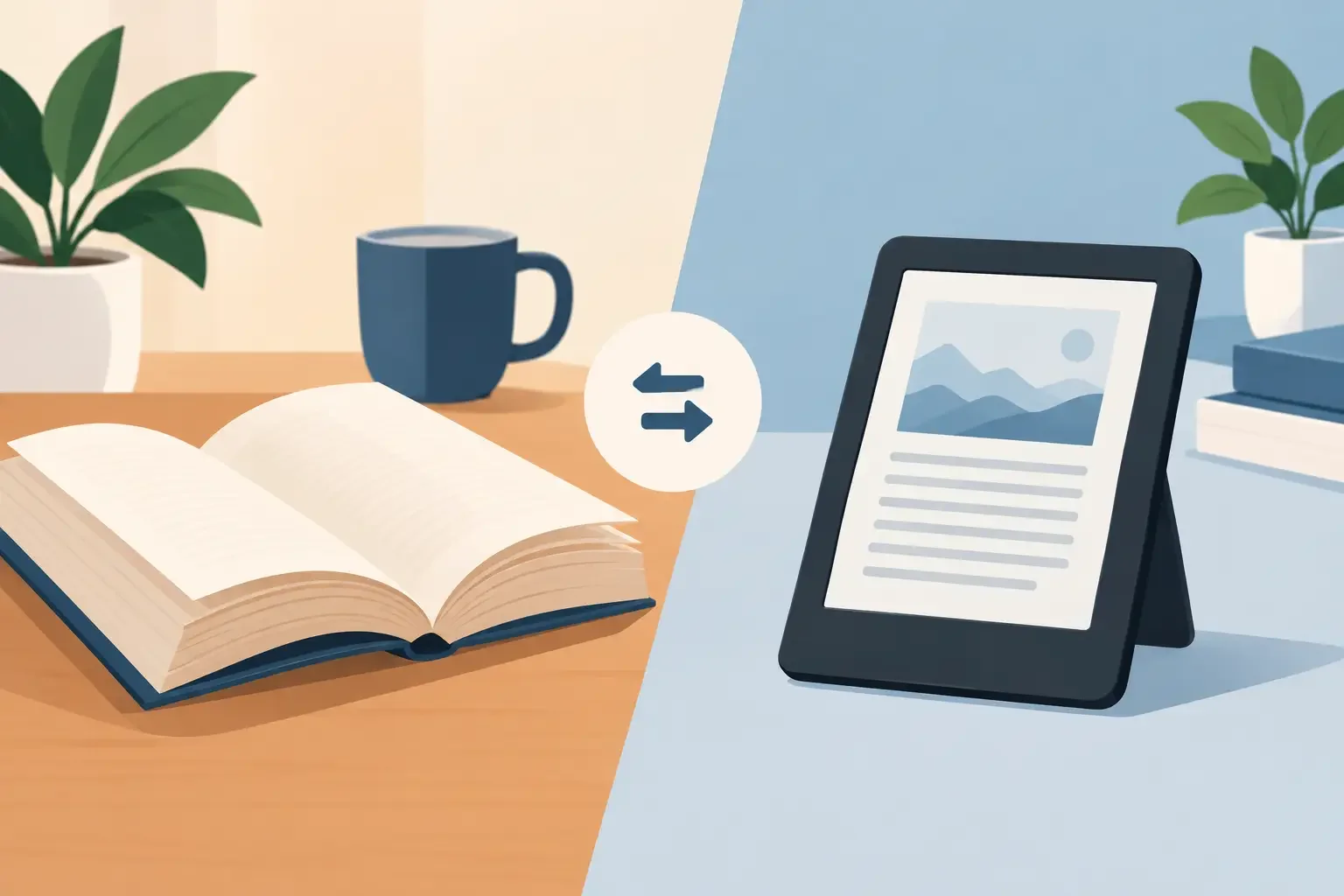
A killer gets closer. A secret starts to crack. You reach the chapter break with your pulse up and one question left: do you turn a paper page or tap a screen? Paperback versus Kindle reading is not really a fight over which format is superior. It is about which weapon gets you deeper into the story with the least friction.
For readers who live for midnight chases, buried bodies, alien wars, and one-more-chapter endings, format changes the experience. A paperback has weight, texture, and a place on the shelf after the smoke clears. A Kindle puts an entire stack of danger in your hand, ready whenever the real world gets boring.
Paperback Versus Kindle Reading: The Real Difference
The biggest difference is not ink versus pixels. It is how each format behaves when your reading life gets messy.
A paperback is a physical commitment. You feel its bulk in a backpack, see the cover on the nightstand, and remember exactly how far you have traveled through the story. That physical presence can make a novel feel more immersive. When a detective enters the final trap or a survivor makes the worst possible decision, the pages in your hand make the moment feel tangible.
A Kindle is built for momentum. It starts instantly, fits in a jacket pocket or carry-on, and lets you carry a full library without choosing which book to leave behind. If you finish a thriller on a flight, in a waiting room, or at 1:30 a.m., the next book can be there before the adrenaline wears off.
Neither format makes a great story better written. But the right format can make it easier to stay inside the story long enough for the plot to hit hard.
Why Paperbacks Still Hit Different
Paperbacks have survived every prediction of their death for a reason. Reading one is tactile and deliberate. You can flip back to that suspicious clue from three chapters ago, thumb through the pages after a shocking reveal, or close the book over your finger when life interrupts at the worst possible moment.
For mystery and thriller readers, that ability to physically investigate the book matters. You may remember that clue was somewhere near the beginning, on the left-hand page, halfway down. It sounds small, but the brain often anchors information to place. A paperback lets the story occupy real space.
There is also the cover. Genre fiction covers make a promise before page one: danger ahead, a monster in the dark, a car headed for disaster, a city about to burn. On a paperback, the artwork gets its full moment. The book becomes an object worth displaying, lending, rereading, or keeping as proof that you survived the ride.
A signed paperback adds another layer. It is not just a container for the story. It is a direct connection between reader and author, especially when you follow an indie writer whose next release might jump from murder and mayhem to cosmic survival.
Paperbacks work especially well if you read at home, collect books, like to share them, or need a break from glowing screens. They are also refreshingly hard to distract. No notifications. No accidental trip into email. Just you, the suspect, and the bad decision waiting on the next page.
The downside is simple: paperbacks take up room. They can get bent, wet, lost, or left behind. A thick novel can feel heavy during a commute, and buying several new releases in print usually costs more than buying digital editions.
Where Kindle Wins the Chase
Kindle reading is built for readers who never want to be caught without a book. One small device can hold a backlist of thrillers, a stack of sci-fi adventures, a paranormal series, and the new release you swore you would save for the weekend.
That convenience is not trivial. The best reading habit is the one that survives real life. A Kindle can sit in a work bag, on a bedside table, or in a car console without demanding much space. If you find ten minutes between appointments, you can drop straight back into the action.
Adjustable text is another serious advantage. You can enlarge the font when your eyes are tired, change the spacing, and read in low light without waking anyone beside you. For readers dealing with vision changes, migraines, or fatigue, those controls can turn a book from frustrating into accessible.
Digital editions can also make series reading easier on the wallet, particularly for heavy readers who finish multiple books a month. Kindle Unlimited may be a strong fit if you enjoy sampling new authors and moving fast through a long list of genre titles. You are less likely to hesitate over a risky pick when the barrier to starting is low.
Search functions help, too. Forgot the name of a minor character who suddenly becomes important? Search it. Need to check where a sinister organization first appeared? Find it in seconds. That is useful in sprawling science fiction, mystery series, and stories with enough suspects to fill a locked room.
Still, a Kindle has its own weaknesses. Digital ownership can feel less permanent than a book on your shelf. You cannot easily hand a friend your copy, admire its cover across the room, or feel the satisfying evidence of 400 pages conquered. And although e-ink screens are easy on the eyes for many readers, some people simply do not connect with reading on a device.
The Best Format Depends on the Mission
Choose paperback when you want the full physical experience. It is the format for a rainy weekend, a quiet porch, a signed edition, or a story you expect to keep after the final twist lands. It is also ideal when a book feels like an event rather than something you want to consume between errands.
Choose Kindle when speed and portability matter most. It is perfect for travel, late-night reading, cramped spaces, and readers who burn through books fast. If your mood changes without warning, a Kindle lets you switch from a serial killer investigation to a spaceship under attack without adding a pound to your bag.
Many committed readers use both, and that is often the smartest answer. Kindle handles convenience. Paperback handles collecting, gifting, and the books that deserve a permanent place in your personal arsenal. You do not need to swear loyalty to one camp.
There is even a practical hybrid move: start a new book digitally when you need instant access, then buy the paperback later if it earns a spot on the shelf. A story that grabs you by the throat and refuses to let go is worth owning in the format that makes you happiest.
Reading Speed, Focus, and the One-More-Chapter Problem
Some readers finish ebooks faster because tapping is effortless and the percentage tracker creates forward motion. Others read paperbacks faster because they are less tempted to check messages, browse stores, or quit when the screen feels like another device demanding attention.
The answer comes down to your habits, not a universal rule. If you already spend all day staring at screens, paper may give your brain a cleaner escape route. If you read in stolen moments and hate carrying extra weight, Kindle removes every excuse.
Do not overthink the statistics. The better format is the one that gets you past page fifty, through the false victory, and into the final stretch where everything goes wrong. A book unread is just ammunition left in the box.
Make the Choice That Keeps the Story Moving
Try this test with your next read. Ask where you will read it, when you will read it, and whether you want to keep it when the last page is done. Those three answers usually settle the argument faster than any feature comparison.
Pick paperback when you want an object with scars, weight, and staying power. Pick Kindle when you want a loaded library ready at a moment's notice. Then stop debating, open the first chapter, and let the trouble begin.