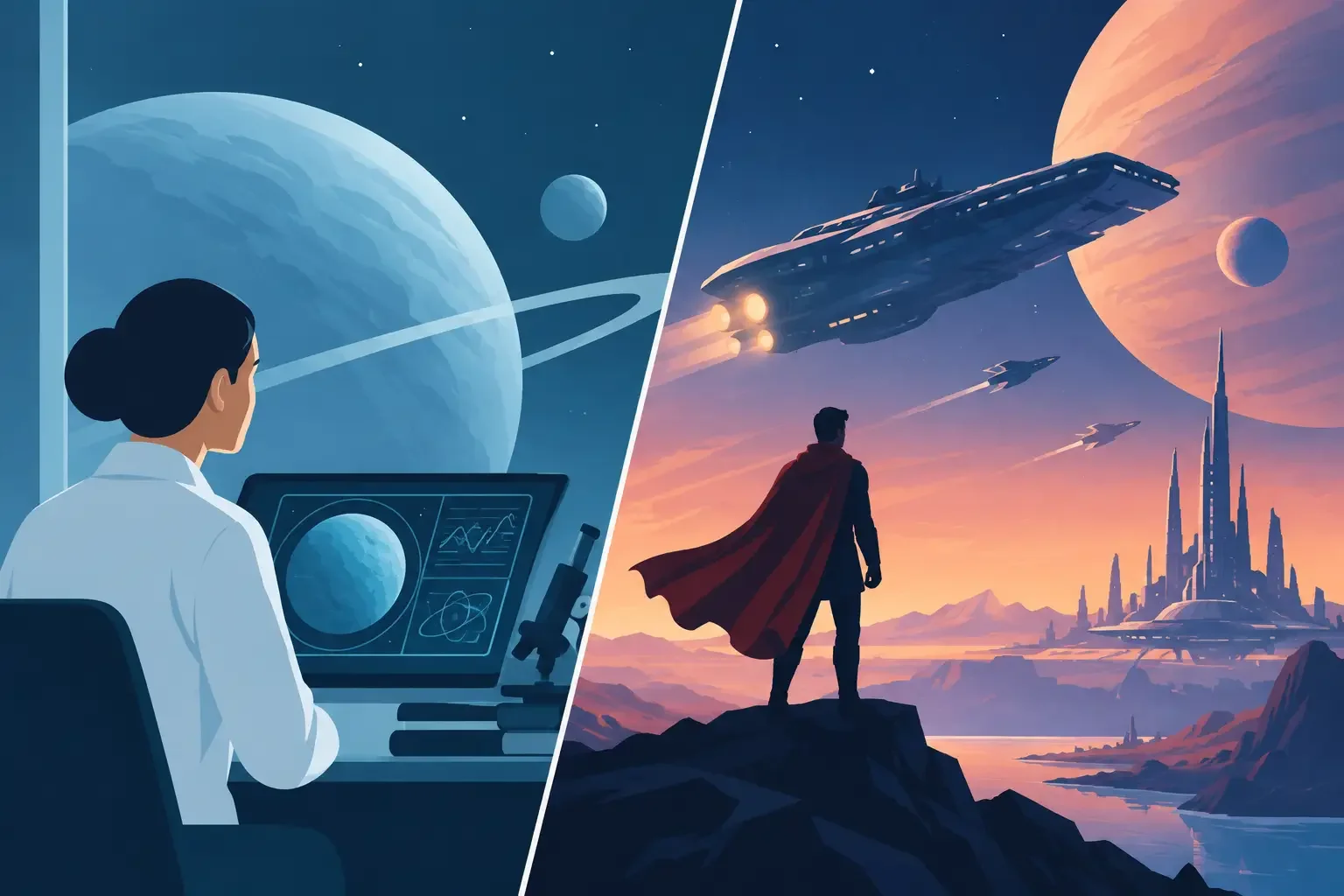
A dying star. A stolen warship. A scientist with one impossible equation and no time left to prove it. Put those ingredients on the page and you may have science fiction, space opera, or both with the throttle pinned to the floor.
The science fiction versus space opera question matters because the labels shape expectations. One reader wants an idea that twists the brain like a pressure valve. Another wants starfighters screaming through laser fire while an outnumbered crew tries to stop an empire from turning whole planets to ash. Both are built for escape. They just take different routes through the stars.
Science Fiction Versus Space Opera: The Core Divide
Science fiction is the wider category. It asks what happens when science, technology, alien life, space travel, or a changed society pushes humanity into unfamiliar territory. The engine can be a new invention, a discovery, a catastrophe, or a scientific possibility taken to its logical and terrifying extreme.
Space opera is a branch of science fiction that goes big on scale, speed, and emotion. Think interstellar conflict, strange worlds, ruthless regimes, desperate rebels, ancient weapons, family betrayals, and crews facing odds that would make sensible people run for the nearest escape pod. The science may be present, but it rarely needs to stop the action for a full technical briefing.
That is the clean distinction: science fiction often puts the speculative idea in the center of the blast radius. Space opera puts characters and epic conflict there.
Neither approach is automatically smarter, deeper, or more entertaining. A quiet story about memory implants can hit like a hammer. A galaxy-wide war can be as sharp and thoughtful as any laboratory-driven premise. The difference is usually about emphasis.
What Science Fiction Usually Promises
At its core, science fiction asks a hard question and follows the consequences. What if a colony ship reaches a planet that was never empty? What if artificial intelligence learns fear? What if time travel works, but every trip strips away a piece of the traveler’s identity? The story may feature combat and danger, but the premise has weight. It changes the rules of life.
Hard science fiction leans heavily into scientific plausibility. Orbital mechanics, resource limits, radiation exposure, biology, and the brutal math of deep space can become part of the suspense. A ship cannot simply jump across the galaxy because the plot needs it to. Fuel runs low. Communication takes years. One bad calculation kills everyone.
Softer science fiction is less interested in equations and more focused on social, psychological, or political fallout. A future city controlled by predictive algorithms may not explain every circuit board, but it can still examine power, freedom, class, and paranoia with real bite.
For readers, the appeal is the feeling that the impossible has rules. The future is strange, but it is not random. Every breakthrough carries a cost, and someone has to pay it.
The pace can be fast, but the idea leads
Science fiction does not have to mean slow, clinical, or dense. A survival story on Mars can move like a thriller. A first-contact mission can become a nightmare in one transmission. But the tension often comes from solving a problem: how to survive, understand, escape, or prevent a technological disaster.
If you enjoy stories where the danger grows from a believable concept, science fiction is likely your territory. You are not just watching the explosion. You want to know what caused it, what the shock wave does next, and whether the people caught inside can adapt before it is too late.
What Space Opera Brings to the Fight
Space opera is built for velocity. It takes the vastness of space and turns it into a stage for war, romance, revenge, loyalty, and spectacular ruin. The galaxy is not merely a setting. It is a battlefield with a thousand front lines.
A space opera protagonist might be a rogue pilot, disgraced commander, smuggler, rebel heir, bounty hunter, or soldier who discovers the mission is bigger than anyone expected. They may start with one job - steal a data core, rescue a prisoner, outrun a fleet - and end up holding the fate of worlds in their hands.
The technology is often dramatic rather than exhaustively explained. Faster-than-light travel gets the crew to the next crisis. Energy weapons burn through hull plating. Alien artifacts wake up after ten thousand years. If the machinery serves the momentum, space opera is happy to let it roar.
Big stakes, personal wounds
The best space opera does not rely on scale alone. A million ships in orbit mean little if nobody has something to lose. The real fuel is personal: the captain who abandoned a friend, the heir forced to choose between bloodline and conscience, the survivor hunting the warlord who erased their home.
That is why space opera can feel so immediate. The setting is massive, but the emotional target stays close. A galactic empire is terrifying. An empire that has your brother in chains is worse.
Readers who want cinematic action, hard choices, dangerous alliances, and chapter endings that demand one more page will often find space opera more satisfying. It is not afraid of a huge moment. It wants the collapsing moon, the last stand in the hangar bay, and the impossible jump through enemy fire.
The Gray Area Is Where It Gets Good
Trying to separate these genres with a laser-straight line can get messy fast. Many stories are both science fiction and space opera. A novel can feature a rigorously imagined future while also delivering fleet battles, political coups, and a hero with a blaster at their side.
The deciding question is simple: what would remain if you removed the scientific concept? If the story falls apart because the central technology or discovery drives every conflict, it leans science fiction. If the heart of the story is a sweeping struggle between characters and powers across the stars, it leans space opera.
Consider a crew investigating a signal from an alien civilization. If the tension centers on decoding the signal and confronting what it reveals about consciousness, it is likely science fiction first. If the signal points to a superweapon and triggers a race between rival empires, it is probably space opera first. The same signal. A different engine.
There is also room for military science fiction, which often sits between the two. It can focus on tactics, chain of command, weapons, and the human cost of war. Some military sci-fi is grounded and procedural. Some is so grand, mythic, and galaxy-spanning that it slides straight into space opera.
How to Choose Your Next Read
Choose science fiction when you want a premise with teeth. You may be in the mood for an unsettling future, a survival problem with no easy answer, or a technology that forces people to reveal exactly who they are under pressure. Expect the unknown to be part of the threat.
Choose space opera when you want the volume turned up. You want starships, rival factions, shadowy conspiracies, impossible missions, and characters who keep moving because stopping means death. Expect bold emotion and a wider canvas.
If you want both, look for stories described as action-packed science fiction, military sci-fi, or epic space opera. Those labels often signal a blend of high-concept danger and relentless momentum. Just remember that marketing terms can be loose. The back-cover premise usually tells you more than the shelf label.
A few clues help. Words like “first contact,” “terraforming,” “AI,” “colony,” and “experimental technology” often point toward science fiction. “Rebellion,” “empire,” “fleet,” “galactic war,” “lost throne,” and “ancient weapon” usually signal space opera. None of these are iron laws, but they are useful warning lights on the control panel.
Why the Difference Matters Less Than the Payoff
Genres are promises, not prison cells. A reader may pick up a book for the space battles and stay for the moral dilemma. Another may arrive for the thought experiment and discover they love a desperate chase through a burning orbital station.
The strongest stories know what they are delivering. They do not bury a quiet scientific mystery beneath cover copy that promises nonstop warfare. They do not sell a galaxy-wide rebellion and then spend three hundred pages avoiding the rebellion. The label should prepare the reader for the ride, not trick them into buying a different ticket.
So choose the story that matches your appetite right now. If you want a question that haunts you after the last page, reach for science fiction. If you want a crew under fire, a villain closing in, and a whole galaxy ready to explode, grab a space opera. And if a book gives you both, strap in. The stars are about to get loud.