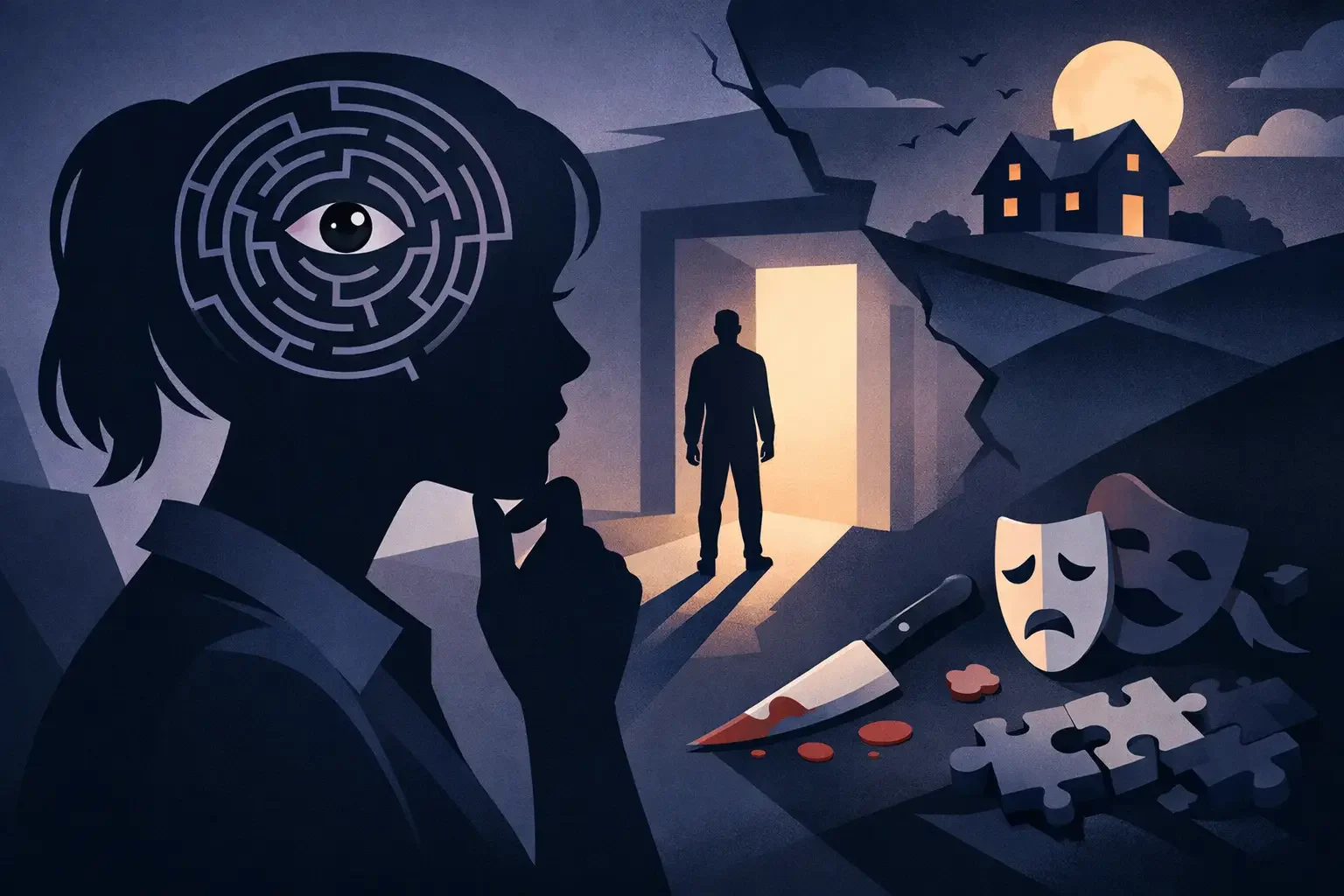
A locked door is scary. A locked door with a voice on the other side claiming to be your dead sister is worse. That is the pressure point behind what makes a psychological thriller gripping: the danger does not only come from a killer, a weapon, or a dark road. It comes from the terrible possibility that the person trying to survive may not understand what is real.
Psychological thrillers hit hard because they turn the mind into a crime scene. Every memory can be planted. Every witness can be lying. Every safe room can become a trap once doubt gets inside. The best ones make readers race forward for answers while quietly making them question every answer they get.
What Makes a Psychological Thriller Gripping?
A gripping psychological thriller runs on two engines at once. One is the external threat: someone is missing, a body has turned up, a stalker is closing in, or an old crime is about to explode. The other is internal: fear, guilt, grief, obsession, paranoia, addiction, trauma, or a memory that will not stay still.
If the outside danger is all that matters, the story can become a standard chase. If the character's inner pain is all that matters, it can lose momentum. Put the two together, though, and every decision carries a charge. The protagonist cannot simply outrun the threat because part of the threat may be living inside their own head.
That is where the genre gets its claws in. Readers are not just asking, “Who did it?” They are asking, “Can this person be trusted?” Sometimes the most terrifying answer is no.
The Main Character Has Something to Lose
A psychological thriller needs a protagonist under pressure, but pressure means little without a personal cost. Maybe a detective is hunting the man who destroyed her family. Maybe a father is trying to find a child nobody else believes exists. Maybe a woman returns to her hometown and realizes the people who ruined her life are still watching.
The stakes must cut deeper than survival. Survival is powerful, but the reader needs to understand what emotional wound will split open if the protagonist fails. A character trying to clear their name wants more than freedom. They want their identity back. A character facing a violent ex may also be fighting the old lie that they were weak, crazy, or impossible to love.
Flaws make that fight sharper. The hero may lie too easily, push away allies, chase control, or mistake revenge for justice. Those flaws should complicate the plot, not just decorate a character sheet. When the protagonist makes a bad choice, it should send the story into a darker corridor.
Vulnerability Beats Invincibility
Action heroes can take a beating and keep moving. Psychological-thriller protagonists can do that too, but the more frightening wound is often invisible. They are exhausted. They are ashamed. They are afraid the people around them are right about them.
That vulnerability creates uncertainty. Readers will stick with a damaged character if that character keeps fighting, even when the fight is ugly. Perfect people are hard to fear for. People one bad night away from breaking are impossible to ignore.
The Truth Arrives in Pieces
A thriller dies when it gives away the game too soon. Suspense needs information, but it needs controlled information. Give readers enough to make a theory, then crack that theory with one fresh detail: a timeline that does not fit, a photograph with someone missing from it, a voicemail recorded after its sender supposedly died.
This is not about hiding everything until the final chapter. A twist with no groundwork feels like a cheap trick. The strongest reveals make readers look back and realize the clues were sitting in plain sight, covered by a believable lie.
A good psychological thriller also understands that facts are not the same as truth. A character can find proof and still misunderstand what it means. A husband may have lied about where he was, but not for the reason his wife thinks. A confession may be real, yet it may protect someone worse.
The result is forward motion. Every revelation closes one door and opens a more dangerous one.
Unreliable Minds Make Every Scene Dangerous
An unreliable narrator is one of the genre's favorite weapons, and for good reason. It puts the reader in the passenger seat of a car whose driver may be drunk, terrified, manipulated, or deliberately taking the wrong road.
But unreliability works only when it has a purpose. If the narrator conceals key facts simply to fool the audience, readers may feel cheated. If memory loss, denial, medication, trauma, or deception grows naturally from the character and the conflict, doubt becomes part of the story's atmosphere.
The trick is balance. Readers need solid ground often enough to stay invested. They need to know what the protagonist wants, what the danger feels like, and why the next move matters. Then the story can pull that ground out from under them at exactly the wrong moment.
Sometimes the protagonist is not unreliable at all. The world around them is. Gaslighting, institutional cover-ups, family secrets, and a town united by silence can create the same suffocating effect. The character knows something is wrong. Nobody will admit it. Now every conversation becomes a potential ambush.
Pacing Is Not Just Speed
Fast pacing is essential, but nonstop chaos is not the same thing as suspense. If every chapter is a car crash, a gunshot, or a scream in the dark, readers can go numb. The best psychological thrillers alternate impact with anticipation.
A quiet scene can be brutal when the reader knows what the character does not. A woman washing blood from her hands is tense. A woman washing blood from her hands while her husband asks why she is taking so long is worse. Nothing explodes, but the fuse is burning.
Pacing comes from consequences. Every choice should make the next choice harder. The protagonist breaks into a house and finds evidence. Now the owner knows. They confront a suspect and lose the only witness willing to talk. They tell the truth and discover that truth makes them look guilty.
That chain reaction is what keeps pages turning. The story is not merely moving. It is tightening.
The Threat Feels Personal
A masked killer can be terrifying. A killer who knows the protagonist's childhood nickname is terrifying in a way that lingers. Psychological thrillers become gripping when the threat invades private territory: the home, the marriage, the past, the phone, the mirror.
The antagonist does not need to be physically present in every scene. In fact, absence can make them more powerful. A message with no signature. A familiar song playing from an empty room. A detail from the protagonist's past that no stranger should know. Those moments tell readers the enemy is already close.
The strongest villains also have a clear connection to the protagonist's weakness. They exploit a fear, a buried mistake, or a need for approval. They do not just want to win. They want to make the hero doubt their own version of reality.
Twists Must Change the Story
A twist is not a surprise for surprise's sake. It should force a new understanding of the stakes. Learning that the neighbor is the killer is only useful if it changes what the protagonist can do, who they can trust, or what the real danger has been all along.
The best twists hit on three levels. They shock the reader in the moment, make sense in hindsight, and create a fresh problem that cannot be solved by simply calling the police. Maybe the missing person staged their disappearance. Maybe the protagonist's closest ally has been protecting them from a truth they begged to forget. Maybe the villain was never after revenge. They were after a confession.
Not every thriller needs six twists and a final-page rug pull. Too many reversals can turn tension into noise. Sometimes one savage reveal, delivered at the exact right time, does more damage than a dozen fake-outs.
A Dark Ending Can Still Feel Satisfying
Psychological thrillers do not need cheerful endings. They need earned endings. Justice may arrive bloody, incomplete, or far too late. The protagonist may survive but lose the life they thought they were fighting to save. The final truth may hurt worse than the lie.
What matters is emotional payoff. The ending should answer the central question and show the price of getting that answer. If the story has built its suspense around trust, the final scene should reveal what trust cost. If it has built around guilt, the ending should force the character to face it.
The last pages should leave a mark. Not because they are confusing, but because they feel inevitable once the truth is exposed.
A gripping psychological thriller makes readers suspicious of the empty hallway, the deleted message, and the person sleeping beside them. Give them a character with a wound, a secret with teeth, and no safe way out. Then make the next chapter feel like the only place they can run.