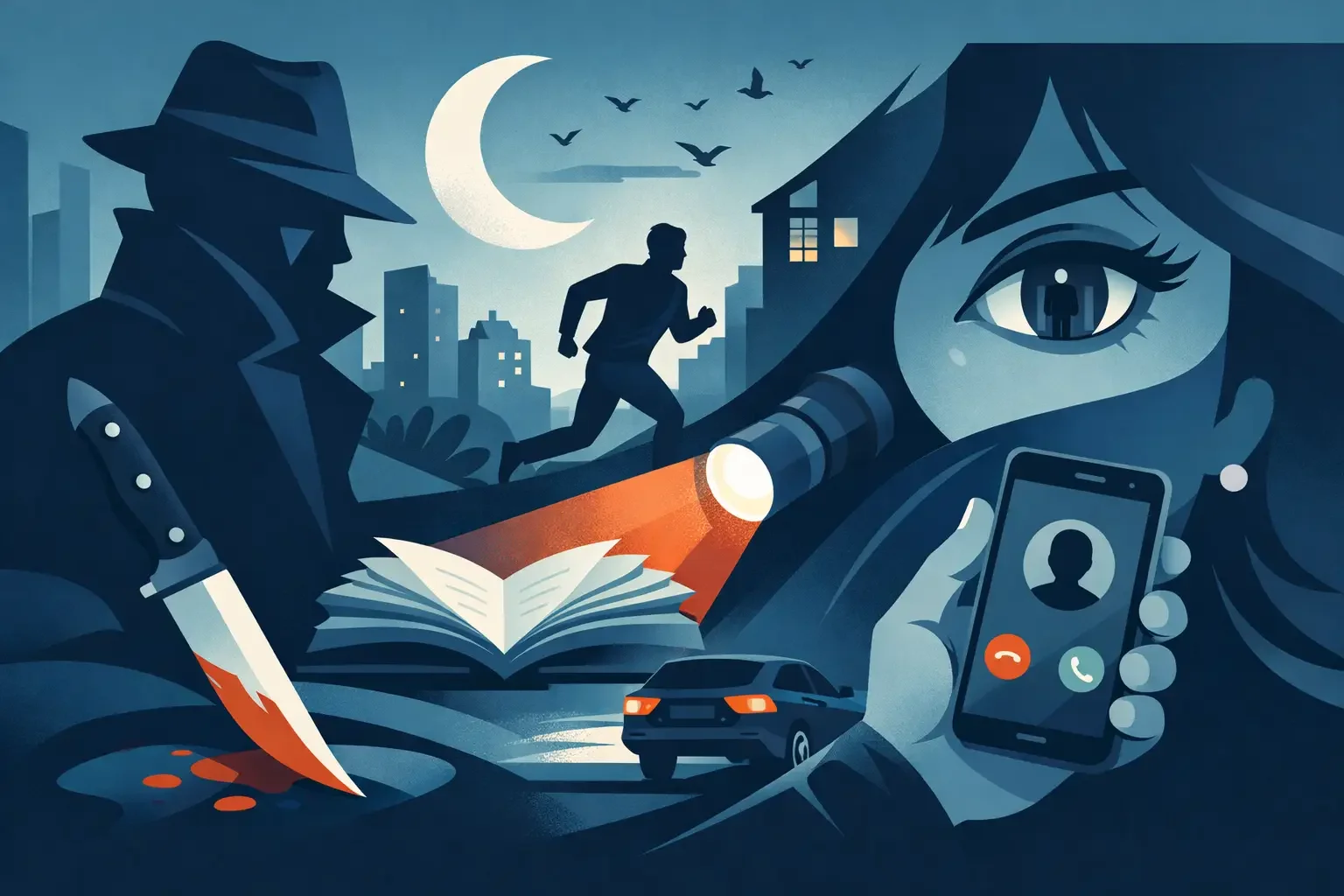
A body in the trunk. A stranger at the door. A detective who realizes the killer knows where her daughter goes to school. What makes a thriller addictive is not simply the crime or the chaos. It is the sickening feeling that something is about to go wrong - and the absolute need to see who survives it.
The best thrillers do not politely ask for your attention. They grab you by the collar, shove a loaded problem into your hands, and make every chapter feel like the last safe stretch of road before the bridge disappears. A great thriller turns reading into a bad idea at midnight because just one more chapter becomes ten.
What Makes a Thriller Addictive Starts With Pressure
Addiction begins with pressure. Not vague danger somewhere in the background, but immediate trouble that closes in fast. A woman wakes up with blood on her hands and no memory of the night before. A race car driver learns a wreck was not an accident. A grieving father receives a message from the son he buried.
The setup needs a fuse. Readers should understand early that the protagonist cannot simply walk away, call it a day, or wait for the authorities to handle it. Something is at risk right now: a life, a family, freedom, sanity, a town, a secret that can destroy everything.
High stakes do not always mean a bigger body count. Saving the world can be thrilling, but so can keeping one terrified child alive until sunrise. The scale matters less than the personal cost. If the danger cuts straight through a character's deepest fear, readers feel every tightening turn of the screw.
1. The Clock Is Ticking
A thriller without a deadline can still work, but it has to find another way to create urgency. Time is the cleanest weapon in the genre. The kidnapped victim has forty-eight hours. The storm hits at midnight. The evidence gets destroyed at dawn. The killer is moving toward the next name on a list.
A ticking clock does more than speed up the plot. It forces bad choices. Characters act with incomplete information, trust the wrong person, take a dangerous shortcut, or leave somebody behind. Those choices create consequences, and consequences create the momentum that keeps pages turning.
The strongest clocks feel unavoidable rather than arbitrary. A deadline should grow naturally from the threat. If it exists only because the story needs a countdown, readers can feel the machinery. But when the clock is built into the danger, every lost minute lands like a punch.
2. A Protagonist With Something to Lose
Readers will follow a flawed character into hell if the reason is real.
The addictive thriller protagonist is rarely a perfect hero. Maybe she is reckless, angry, compromised, or carrying guilt from the one case she could not solve. Maybe he is the wrong man for the job, but the only one who knows where the bodies are buried. Imperfection gives danger teeth because mistakes are believable.
What matters is that the character wants something beyond survival. They want redemption. They want revenge. They want to protect the person they failed before. They want the truth, even when the truth is going to burn down the life they built.
That emotional engine separates empty action from action that hits hard. A car chase is noise if nobody has anything to lose. Put a character's brother in the passenger seat, let the brakes fail, and make the pursuing vehicle someone they once loved. Now the chase has blood in it.
3. Information Comes in Dangerous Doses
Thrillers run on questions. Who did it? Why now? What is being hidden? Who is lying? The trick is giving readers enough information to form a theory, then slipping a blade between the ribs of that theory a few chapters later.
Too much mystery can become frustrating. If every answer is withheld, the story feels evasive instead of suspenseful. Too much explanation kills the pulse. The reader should regularly get a payoff - a clue, a revelation, a partial answer - only to discover that the answer opens a worse question.
This is why secrets work so well. A secret is not merely information a character does not know. It is information with consequences. When the truth could ruin a marriage, expose a killer, trigger a cover-up, or prove that the hero has been hunting the wrong target, readers cannot look away.
4. The Threat Feels Smart and Close
A shadowy threat can be creepy. A threat that understands the hero is addictive.
The best villains and antagonistic forces do not wait around to be defeated. They adapt. They set traps. They exploit old wounds. They know what the protagonist will do because they have studied them, shaped them, or share the same dark instincts.
This does not require a superhuman mastermind in every story. The threat might be a corrupt sheriff, an impossible weather event, a hostile force beyond Earth, or a witness who has every reason to lie. What matters is resistance. The protagonist pushes forward, and the danger pushes back harder.
When the enemy can reach into the hero's supposedly safe world, suspense spikes. Home is no longer safe. Friends become suspects. The phone rings, and nobody wants to answer it.
5. Every Win Makes the Situation Worse
An addictive thriller does not move in a straight line toward victory. It tightens.
The hero finds the missing witness, but the witness is injured and has no idea who attacked them. The detective identifies the killer, but the killer has planted evidence. The crew escapes the wreckage, only to realize the escape route leads directly into hostile territory.
This pattern matters because it prevents the middle of the book from going soft. Each breakthrough should cost something: time, trust, safety, a useful ally, or the illusion that the protagonist is in control. Readers keep going because they want relief, but the story keeps making relief more expensive.
There is a trade-off here. Relentless escalation without breathing room can become exhausting. Quiet scenes earn their place when they deepen a relationship, reveal a hidden motive, or give the reader a moment to dread what comes next. The pause is not dead air. It is the moment before the gunshot.
6. Twists Change the Meaning of What Came Before
A twist is not addictive because it is shocking. It is addictive because it rearranges the story in the reader's mind.
The strongest twists feel surprising in the moment and obvious afterward. The clues were there. The reader saw them, but interpreted them the wrong way. That is the sweet spot: surprise with a trail of evidence behind it.
A random revelation can create a brief jolt, but it does not build trust. If the killer turns out to be an unknown twin, a hidden organization, or a character who has barely appeared, readers may feel tricked rather than thrilled. Good twists come from character, motive, and pressure. They expose what someone was willing to do when backed into a corner.
Better still, the twist should force a new decision. Learning the truth is not enough. The protagonist now has to act on it, usually while the clock is louder than ever.
7. The Ending Delivers a Real Hit
Readers forgive a lot when a thriller lands its ending. They will ride through a wild premise, a brutal detour, even a few improbable escapes if the final confrontation delivers emotional payoff.
That does not mean every ending needs a neat bow. Some stories should leave scars. Some should leave a question hanging in the dark. But the central promise must be paid off. If the story asks whether the hero can save his family, expose the murderer, outrun the threat, or face the truth about themselves, the ending needs to confront that question head-on.
The final pages should feel earned because the protagonist has changed, paid a price, or made a choice they could not have made at the beginning. Explosions are fun. Justice is satisfying. But the moment that sticks is often smaller: the phone call that never comes, the empty chair at the table, the hero walking away from the life they thought they wanted.
A thriller becomes addictive when it gives readers danger with a pulse. Put someone worth caring about under impossible pressure. Give them a secret, a deadline, and an enemy that refuses to stay buried. Then make the next chapter feel too dangerous to postpone.