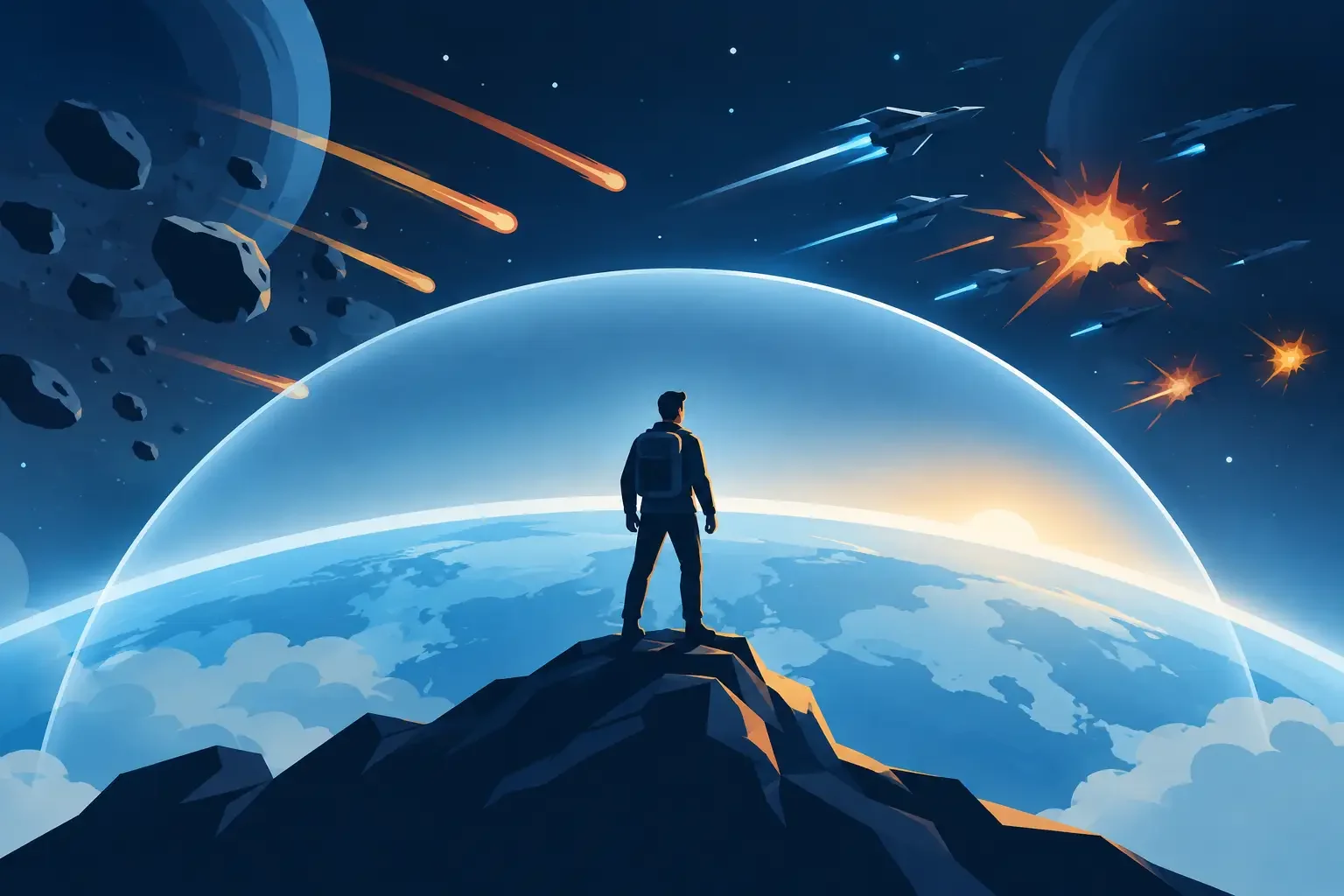
A firefight in a dark alley is dangerous. A firefight on a failing space station is worse. In cosmic warfare, one ruptured bulkhead can turn every person in the room into a frozen corpse before anyone gets a clean shot off. That is the hook. The war is bigger than Earth, but the terror gets brutally personal.
The best stories in this corner of science fiction do not rely on star maps and technical jargon alone. They put people under pressure so extreme that every decision carries a body count. A captain chooses which civilian transport gets left behind. A soldier discovers the enemy knows their name. A colony realizes the fleet sent to save it has arrived to erase it.
Cosmic warfare works because it takes the familiar machinery of action fiction - weapons, betrayals, desperate escapes, last stands - and throws it into a place where there is nowhere to run. Space is vast. A ship is not.
Cosmic Warfare Is More Than Giant Space Battles
Yes, readers come for the warships trading fire above a burning planet. They come for railguns, boarding parties, alien armadas, and fighters screaming through debris fields. A great space battle should feel fast, loud, and impossible to control, even when the characters are staring at it through reinforced glass.
But spectacle is only the first blast. If the battle does not threaten something human, it becomes background noise. The strongest cosmic warfare stories put a face on the cost. Maybe the engineer trying to keep one damaged ship alive has a child on the colony below. Maybe the enemy commander is not a monster but an old friend who believes annihilation is mercy. Maybe the weapon that can win the war will poison an entire system for generations.
That is where the genre gets its teeth. The conflict is not simply fleet versus fleet. It is duty versus survival. Revenge versus restraint. Humanity versus whatever humanity becomes when extinction is waiting at the airlock.
The scale also creates a nasty advantage for writers who love suspense. On Earth, backup may be a phone call away. In deep space, help may be light-years away, delayed by politics, damaged engines, or a signal that never gets through. The crew has what is on board: limited oxygen, failing weapons, frayed nerves, and the awful possibility that someone among them is working for the other side.
The Battlefield Is Trying to Kill Everyone
A war story set in space has two enemies. The obvious enemy carries the guns. The other is the environment itself.
A planet can be hostile, but a spaceship is a pressure vessel moving through a vacuum that does not forgive mistakes. A damaged reactor is not merely a plot complication. It is a countdown. A navigation failure can strand survivors in a dead system. A boarding action becomes savage when a single missed shot could punch a hole through the hull.
This changes the rhythm of action. Characters cannot solve every problem by firing harder. They have to think, improvise, and sometimes make choices that feel worse than losing. Seal a compartment with wounded crew inside or let the entire ship depressurize. Trust the prisoner who claims to know the enemy's plan or leave millions exposed. Fire the superweapon or become the thing you were fighting.
Those constraints make victory feel earned. They also keep the violence sharp. In a grounded cosmic war, every explosion has consequences. Every missile has a destination. Every casualty leaves an empty station at a console when the next crisis hits.
The Enemy Needs a Reason to Be Terrifying
An alien empire with a thousand ships is not frightening because it has a thousand ships. It is frightening because readers understand what that force wants, what it is willing to sacrifice, and what happens if it wins.
The most memorable enemies usually have a logic, even when that logic is horrifying. They may see humans as invaders, disease carriers, useful labor, or a threat that must be wiped out before it spreads. They may be fighting a war older than humanity itself. They may not even recognize individual people as living beings. That last possibility is especially cold: a civilization so vast that an entire human world registers as a minor obstacle.
Still, pure evil has its place when the story wants full-throttle pulp mayhem. Sometimes readers want an enemy that cannot be negotiated with, a black-armored force rolling over worlds while the heroes fight to keep one last flame alive. The trade-off is simple. The more faceless the enemy becomes, the more vivid the protagonists need to be. Someone has to carry the emotional weight when the lasers start flying.
A rival human faction can hit just as hard. Civil wars, corporate fleets, breakaway colonies, and military regimes bring the war close to home. The enemy speaks the same language. They know the same systems. They may even believe they are the heroes. That kind of conflict gives a story room for betrayal and moral damage, especially when the people pulling the trigger once wore the same uniform.
Small Crews Keep a Galactic War Personal
The galaxy may be burning, but readers experience it through a handful of people trapped inside the fire.
A tight crew is often more powerful than a cast of generals and politicians. Put a battle-scarred captain, an untested pilot, a medic with a secret, a cynical mechanic, and a soldier who has lost too much on one ship, then send them behind enemy lines. Suddenly the war has a pulse. Their arguments matter. Their loyalties matter. When one of them does not make it back, the loss is not a statistic on a tactical screen.
This is also where cosmic warfare can cross cleanly into thriller territory. A ship can become a locked-room mystery. Who sabotaged the jump drive? Why is the enemy always waiting at the next destination? What did the captain hide before the war began? The best answers do more than surprise the reader. They force the characters to question whether their side deserves to win.
Personal stakes do not make a massive conflict feel smaller. They make it land harder. Nobody mourns a number. They mourn the pilot who promised to get everyone home and died buying them twenty more seconds.
Winning Should Cost Something
A war without a price feels like a video game with infinite lives. Cosmic warfare becomes memorable when success leaves a mark.
The cost does not have to be death every time. A character can lose trust, rank, home, faith, or the simple belief that the mission was worth it. A liberated planet may be unlivable. The hero may save a civilization only to become a fugitive from the government that ordered the attack. Peace may arrive with a secret buried beneath it, waiting to start the next war.
There is a balance to strike. Relentless misery can flatten momentum just as surely as easy wins. Action readers want danger, but they also want the charge of seeing battered people push forward. Give them a reason to believe the fight matters, then make that belief expensive.
That is the real fuel behind a good cosmic war story. Not the size of the cannon. Not the number of worlds on the map. It is the moment a terrified person looks into the black, knows the odds are impossible, and decides to launch anyway.
When you pick up a story of cosmic warfare, look for the crew with something to lose, the enemy with a nightmare plan, and the one battered ship still standing between home and oblivion. That is where the fireworks become a fight worth remembering.