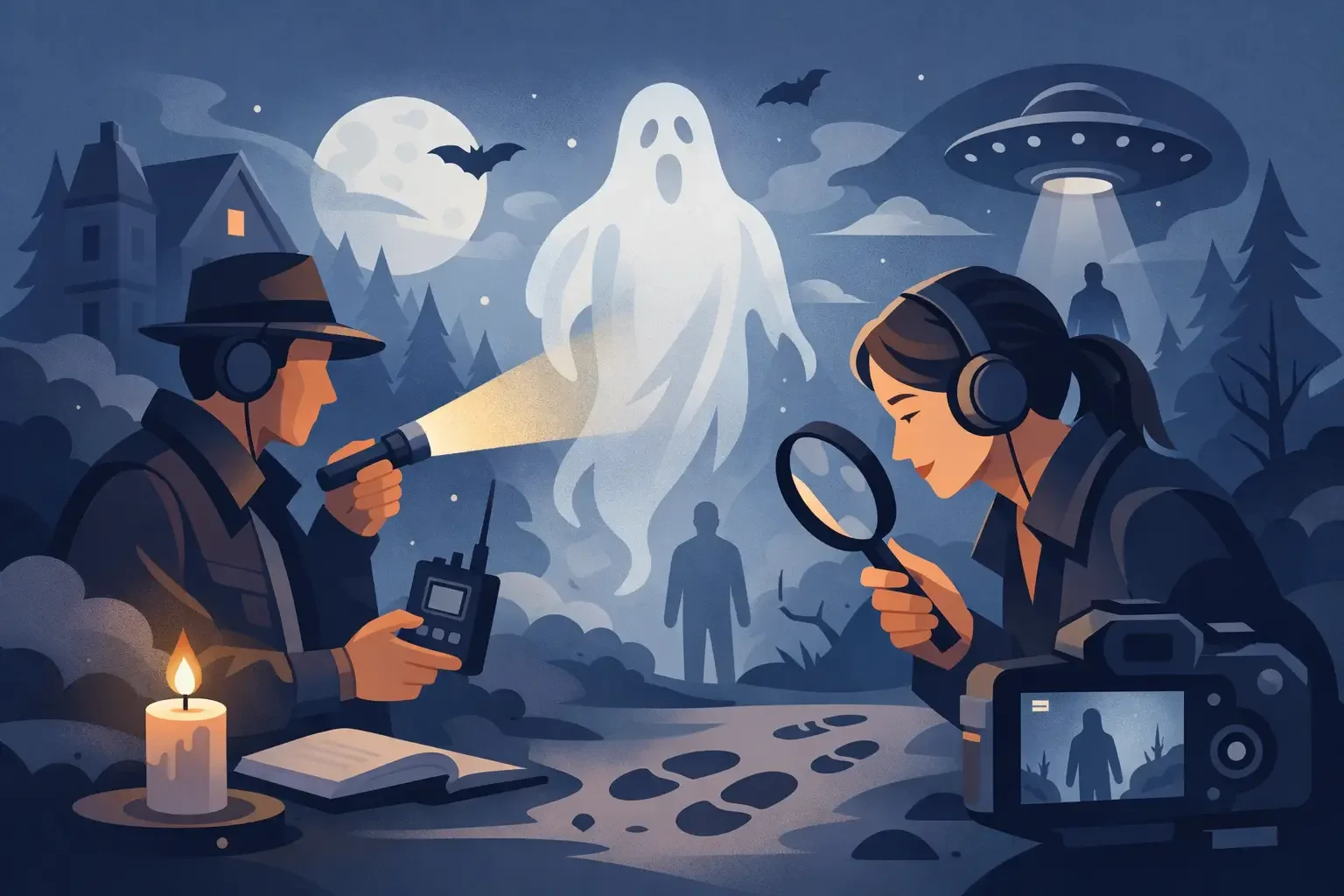
The dead do not leave neat case files. They leave a cold patch in a locked hallway, a voice caught beneath radio static, a child’s toy moving where nobody can reach it. That is how paranormal detectives investigate: not by charging into a haunted house with a flashlight and a prayer, but by treating every strange event as a crime scene with one extra problem - the most important witness may no longer be alive.
The job sits in the shadowy space between investigation, folklore, technology, and nerve. In fiction, that space gets bloodier fast. A missing person case can become a curse. A murder scene can replay itself after midnight. A detective chasing a human killer may discover the killer died fifty years ago and never stopped hunting.
The Case Starts Before the Ghost Shows Up
A good paranormal investigator starts with the living. Before cameras come out and the lights go down, they collect witness statements, study the property, and build a timeline. When did the noises begin? Who saw the figure in the stairwell? What changed before the family started waking with bruises, hearing names whispered through empty rooms, or finding the same muddy footprints at every door?
Details matter because fear edits memory. Two witnesses can experience the same event and remember different versions. One may swear the woman in the mirror wore a red dress. Another may insist she had no face. Instead of picking a favorite story, the detective looks for overlap: time, location, weather, emotional stress, prior deaths, renovations, arguments, and patterns that repeat.
In a hard-edged paranormal mystery, the first report is rarely the real case. The family calling about a ghost may be hiding an old crime. The old crime may have created the haunting. Or the ghost story may be camouflage for something far more human and far more dangerous.
History Is a Weapon
A house is never just a house in paranormal suspense. It has owners, deaths, fires, lawsuits, rumors, and rooms somebody sealed off for a reason. Detectives search public records, newspaper archives, cemetery maps, old photographs, police reports, and personal letters when they can find them. They want names, dates, and motives.
That work often exposes the pressure point. Maybe a local doctor vanished after a patient died. Maybe a railroad worker was buried under a false name. Maybe the land held a prison camp long before a developer built luxury homes over it. The supernatural event becomes more than a jump scare when it has a history with teeth.
There is a trade-off, though. History can explain why a place feels cursed, but it can also lure investigators into forcing every strange sound to fit an old legend. The best detectives stay suspicious of the story they want to be true.
How Paranormal Detectives Investigate Evidence
The gear is part science, part survival kit. Cameras document rooms before and after an incident. Audio recorders capture interviews and long stretches of silence. Temperature readings can reveal drafts, faulty heating, or an unexplained cold zone that keeps appearing in the same spot. Motion sensors, environmental meters, and timestamped logs help investigators compare reports against what was happening in the building.
None of that equipment is a magic truth machine. A camera can catch dust, insects, lens flare, or a reflection and make it look like a floating spirit. Audio can produce false patterns, especially when a frightened listener expects a voice. An electromagnetic reading might come from old wiring, appliances, or electrical panels instead of a dead man standing in the attic.
That skepticism is not a weakness. It is what gives the case weight. First, rule out the ordinary: plumbing, ventilation, carbon monoxide, poor sleep, infrasound, electrical problems, animal activity, pranksters, and deliberate fraud. If the evidence survives those explanations, it becomes more interesting. Not proven, necessarily. Interesting enough to keep digging.
A smart investigator records conditions every time something happens. Was a window open? Who was in the room? Did the recorder run continuously? Was there a passing car, a nearby cell phone, a storm, or a power surge? The difference between a creepy story and a credible case is often one boring detail nobody wanted to check.
The Lockdown Is Where the Pressure Builds
Once the interviews and daytime inspection are finished, the team may conduct a controlled overnight watch. They set cameras at entry points, establish a baseline for sound and temperature, and limit movement through active areas. Nobody gets to wander off because they heard a child laughing in the basement. That is how evidence gets contaminated - or how someone gets hurt.
In fiction, lockdown is where the house fights back. A door slams on camera. A voice says the investigator’s name. A figure crosses a hall that should be empty. The strongest scenes do not rely on random chaos. They pay off what the detective learned earlier. The name in the audio belongs to a victim. The locked nursery sits above the room where the body was hidden. The ghost is not performing. It is pointing.
That distinction changes the investigation. A haunting may be a warning, a memory, a trap, or an accusation. The detective’s job is to determine which one before the next body drops.
The Human Threat Is Usually Closer Than the Grave
Paranormal detectives are often pulled toward the supernatural because it is loud, terrifying, and impossible to ignore. But the living remain capable of the worst things in the story. A grieving heir may fake phenomena to scare tenants away. A cult may use an alleged spirit to control victims. A killer may exploit a local ghost legend because police hesitate to chase what they cannot explain.
That is why investigators keep working both angles. They check alibis. They inspect locks and hidden passages. They look for financial motives, family feuds, missing files, and people who benefit from the fear. A shadow in the corner can be a restless spirit. It can also be a man with a mask, a key, and a plan.
The tension comes from uncertainty. If every case is definitely supernatural, the detective becomes a technician with a gadget bag. If every case has a mundane answer, the ghost is only wallpaper. The best paranormal mysteries keep both possibilities alive until the evidence forces a choice - and sometimes the answer is worse because it is both.
Why the Detective Needs Rules
A paranormal investigator without rules is just another victim waiting for chapter twelve. Rules can be practical: never investigate alone, keep a communication line open, document every entry and exit, and leave when a structure becomes physically unsafe. They can also be supernatural, depending on the story’s world: do not answer a voice that calls from a dark room, do not take an object from the site, and never invite something in simply because you want proof.
Rules create stakes because rules can be broken. The rookie touches the locket. The desperate mother demands a séance. The lead detective ignores the one warning that matches a case from twenty years earlier. Suddenly the investigation is no longer about what haunts the building. It is about what followed them home.
For real-world claims, caution matters even more. Fear can be intense and deeply personal, whether its source is environmental, emotional, criminal, or unexplained. Responsible investigators do not intensify panic, diagnose strangers, or promise certainty they cannot deliver. They document, test, listen, and bring in the right practical help when a situation points to health, safety, or criminal risk.
The Final Reveal Must Cost Something
A paranormal case earns its ending when the answer changes the people trapped inside it. Solving the mystery might mean identifying the forgotten dead, exposing a murderer, returning a stolen object, or forcing a survivor to face the truth they buried. It might also mean accepting that some doors should stay closed.
That is the real engine behind paranormal detective stories. The ghost is never just a ghost. It is unfinished business with a voice, a motive, and a way of turning the past into a loaded weapon.
So when the hallway goes cold and the recorder clicks on by itself, the detective does not ask, “Is this haunted?” The better question is, “What happened here - and who is still paying for it?”