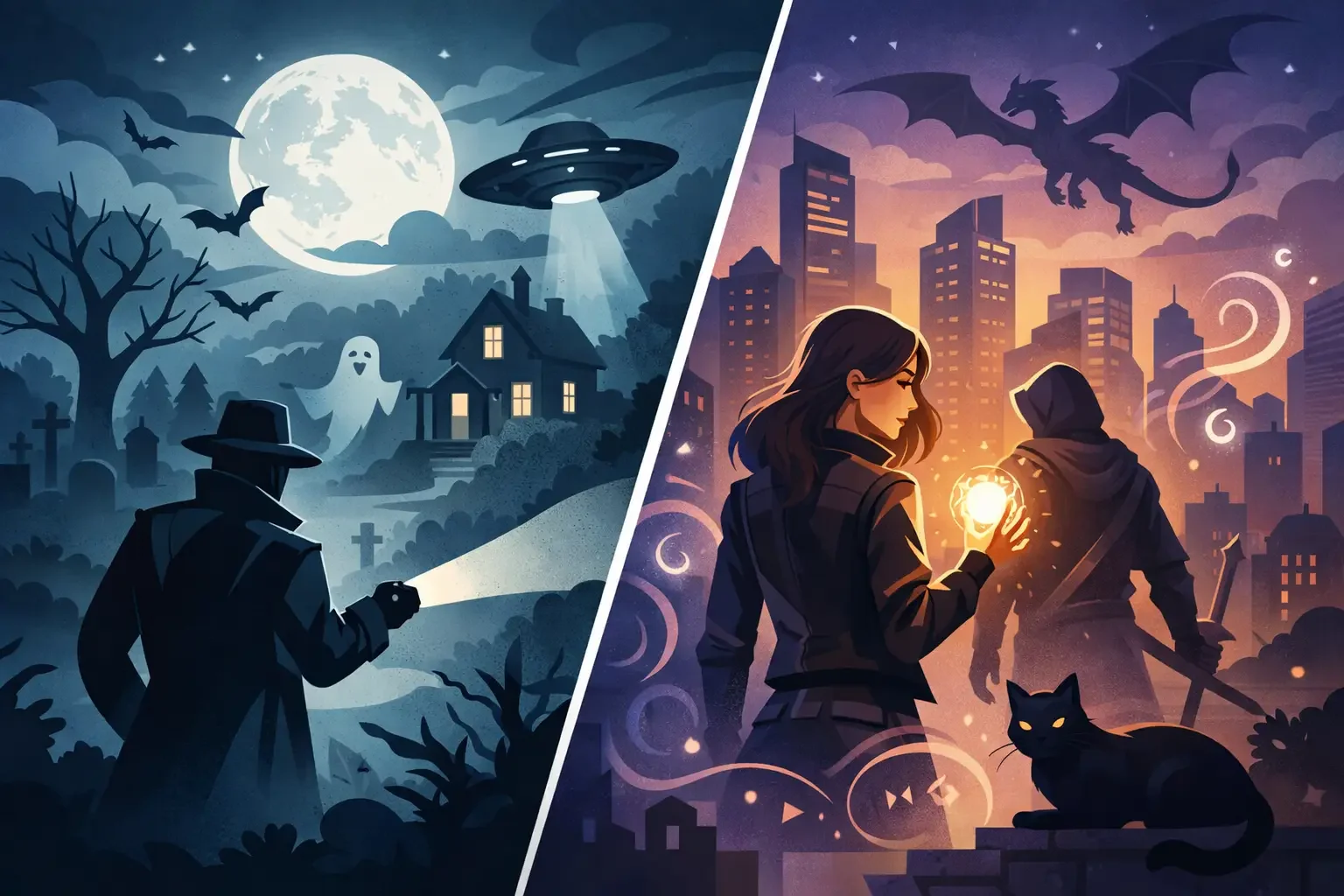
A body turns up in a locked room. The victim has claw marks across his chest, no pulse, and a silver coin shoved under his tongue. Is this the opening move in a murder investigation, or the first warning that vampires, witches, and monsters are about to tear through the city?
That question sits at the heart of paranormal mystery versus urban fantasy. Both genres bring the strange into familiar streets. Both can feature detectives, ghosts, cursed bloodlines, secret societies, and violent supernatural threats. But they run on different engines. One makes you hunt for answers. The other makes you brace for impact.
If you like stories with danger, momentum, and a dark force hiding behind everyday life, knowing the difference helps you grab the book that fits your mood.
Paranormal Mystery Versus Urban Fantasy: The Core Difference
A paranormal mystery is, first and foremost, a mystery. Something is wrong. A crime has been committed, a person has vanished, or an impossible event has shattered the rules of reality. The central question is usually clear: who did it, why did they do it, and how can the truth be proven before someone else dies?
The paranormal element complicates the case. A ghost may be the only witness. A psychic may catch flashes of a killer's memories. A cursed object may leave no fingerprints but plenty of bodies. Supernatural rules create obstacles, false leads, and threats, yet the story's main drive remains investigation.
Urban fantasy flips the priority. It is fantasy set in a modern or recognizable world, often a city where magic lives in the shadows or crashes openly into public life. The protagonist may be a witch, monster hunter, shapeshifter, demon-bound cop, or ordinary civilian dragged into a hidden war. Mystery can absolutely be part of the plot, but it does not have to be the plot.
An urban fantasy novel may ask who opened a portal beneath downtown Chicago. But it can be just as interested in stopping an invading army, surviving a magical turf war, paying off a favor to the fae, or keeping the hero's own dangerous powers under control.
Put simply: paranormal mystery follows the clues. Urban fantasy follows the collision.
What Drives a Paranormal Mystery?
In a paranormal mystery, every eerie detail should point somewhere. The bloodless corpse, the possessed house, the witness who speaks in a dead woman's voice - these are not just cool pieces of atmosphere. They are evidence.
The reader expects a puzzle with an answer. The detective might be a police officer who hates anything supernatural, a private investigator who can talk to the dead, or an amateur sleuth with a personal reason to keep digging. Whatever the setup, the protagonist gathers facts, tests theories, questions suspects, and gets closer to the truth at a cost.
The supernatural can make the mystery nastier because it bends familiar rules. A killer can cross walls. A victim can lie after death. A spell can erase memories. Still, fair-play logic matters. The final reveal should feel earned, even if the answer involves a revenant, a coven, or a demon wearing a human face.
The pacing often builds in a tightening spiral. A clue leads to a threat. A threat exposes a secret. A secret turns the investigation personal. By the end, the hero is not merely solving a case. They are staring into something old, hungry, and far more dangerous than the original crime suggested.
The best fit for clue-chasers
Choose paranormal mystery when you want suspense with a sharp question mark at its center. You want suspects. You want motives. You want the satisfaction of realizing that the strange detail from chapter three was never random.
These books can be atmospheric and brutal, but their biggest payoff is revelation. The killer's identity, the ghost's real purpose, the reason a family has been dying for generations - the truth hits hardest when the clues have been there all along.
What Drives Urban Fantasy?
Urban fantasy is built for escalation. The hero might begin by investigating a dead werewolf or a stolen artifact, but the story can quickly explode into gang wars between magical factions, ancient prophecies, or a battle to keep the human world from being swallowed by hell.
The modern setting matters. A rain-slick alley, a late-night diner, a subway tunnel, a rundown apartment building, and a glittering city skyline can all become battlegrounds. Magic shares space with cell phones, firearms, traffic, surveillance cameras, and exhausted people trying to make rent before a necromancer wrecks the neighborhood.
That contrast gives urban fantasy its punch. The impossible is not locked away in a distant kingdom. It is under the overpass, behind the nightclub, or waiting in the elevator when the lights cut out.
The protagonist is also more likely to have an active supernatural role. They may cast spells, carry enchanted weapons, owe debts to otherworldly powers, or belong to a species that makes normal life impossible. Their personal identity is often tangled into the main conflict. Saving the city may mean confronting the monster inside themselves.
The best fit for action-first readers
Choose urban fantasy when you want magic with tire tracks on it. You want chases, fights, shifting alliances, and a hero who gets thrown into the fire before they have all the answers.
A good urban fantasy story can still deliver a killer mystery. The difference is that solving it may only be one job among several. The hero also has to survive the cult, stop the ritual, protect their people, and make it out before dawn with the city still standing.
Where the Genres Overlap
The line between these genres is not a concrete wall. It is more like a crime scene taped off in a dark alley - useful, but not always neat.
A paranormal mystery can become urban fantasy when the investigation opens onto a larger magical world with ongoing faction conflicts, supernatural politics, and action-heavy stakes. An urban fantasy can feel like paranormal mystery when its plot centers tightly on a murder or disappearance and gives the reader a steady trail of clues.
Series make the overlap even stronger. The first book may begin with a single strange killing. By book three, the detective has learned the city is controlled by vampire houses, the dead are walking, and an ancient god has decided to wake up beneath the courthouse. The mystery remains, but the world expands and the action gets louder.
The deciding factor is not whether there is magic. Both genres have plenty of that. Ask what the book promises to resolve most powerfully. If the final rush is about exposing the truth behind a crime, you are likely in paranormal mystery territory. If the final rush is about surviving a supernatural war or defeating a monstrous force, urban fantasy is probably driving the vehicle.
Tone, Stakes, and Reader Expectations
Paranormal mystery often leans into dread. It can be moody, eerie, and suspicious. The threat may stalk the edges of the story while the investigator works to understand it. Violence can be sudden and ugly, but uncertainty is the weapon. You keep reading because anybody might be lying, and the dead may know more than the living.
Urban fantasy tends to run hotter and wider. Its danger is frequently visible: creatures attack, magic detonates, enemies make demands, and the protagonist has to move now. The mood can still be grim, but it often carries more swagger, banter, and kinetic energy. A bad night can become a supernatural bloodbath by page fifty.
Neither approach is better. It depends on the kind of tension you want. Do you want to sit in a dark room with a case file, studying every detail while something scratches at the window? Or do you want to kick in the door, grab the silver blade, and find out what was making that sound?
How to Pick Your Next Read
Look past the cover art and the word “paranormal.” Book descriptions usually reveal the real engine fast.
If the setup emphasizes a detective, a murder, a missing person, a suspicious death, clues, suspects, or a secret that must be uncovered, expect paranormal mystery. If it emphasizes magical powers, hidden worlds, demon hunters, rival supernatural factions, ancient threats, and a battle to save a city or loved one, expect urban fantasy.
Also watch the scale. Paranormal mystery often starts intimate: one corpse, one haunted property, one impossible case. Urban fantasy may start there too, but it is more likely to widen into a larger conflict. That does not mean paranormal mystery lacks action or urban fantasy lacks brains. The best books in either lane deliver both. They simply decide which pressure point gets squeezed hardest.
When the mood calls for a dead-end clue, a dangerous secret, and a truth with teeth, reach for paranormal mystery. When you want magic, mayhem, and a hero fighting through chaos with no clean exit, choose urban fantasy. Either way, make sure the first chapter leaves something terrible standing in the dark.